Introduction to Center Study
Slides and transcript from the Introduction to Center Study talk at the Avalon Institute Exposition on October 30, 2026.
Thank you to Isaac Friedman (Yitzz) for recording the talk, and to the Avalon Institute for hosting.
I. What Is Center Study?
Thank you all so much for coming out to this introduction to Center Study. It’s a full-circle moment for me, because I went to Cal about ten years ago, and some of the people who first opened my mind to these questions of political philosophy and anthropology are in the audience—Mr. Tivy and others who, in Berkeley at that time, were asking questions about the nature of this social order itself. And those questions led me ultimately to questions of anthropology: What is the nature, or origin, of the human being? During that time I discovered a very strange theory called generative anthropology, which I became totally fixated on and have not stopped thinking about since.
Generative anthropology ultimately became something called Center Study. My goal today is to give you a quick overview of what Center Study is, where it comes from, and what you can do with it. What I want to convince you of is that it’s one of the most powerful ways of thinking I’ve discovered, and that for any of the projects, companies, or prospects you have, it will be an invaluable source of new ideas at a minimum.
Center Study is a discipline similar to existing disciplines like sociology, economics, or political science—but unlike them insofar as Center Study is much more radical than any of these existing disciplines. It’s also, in a way, totally indigestible by those disciplines. It’s hard for the sociologist or the economist to “take in” Center Study and the originary hypothesis—but Center Study is able to metabolize all of them: to infiltrate these different disciplines, the idioms and vocabulary they’ve constructed, the anthropology of the human that they all take as an implicit model for what the human being is. The minimal anthropology, or anthropomorphics, that Center Study is founded on becomes a way of refounding each of these disciplines on the terms of the originary hypothesis, so as to generate a radical new vocabulary that lets us solve the currently unsolvable questions in each discipline—and make each of them able to speak with one another. So Center Study is a discipline like sociology, like economics, like political science; but it’s unlike other disciplines insofar as it’s radically interdisciplinary and radically generative.
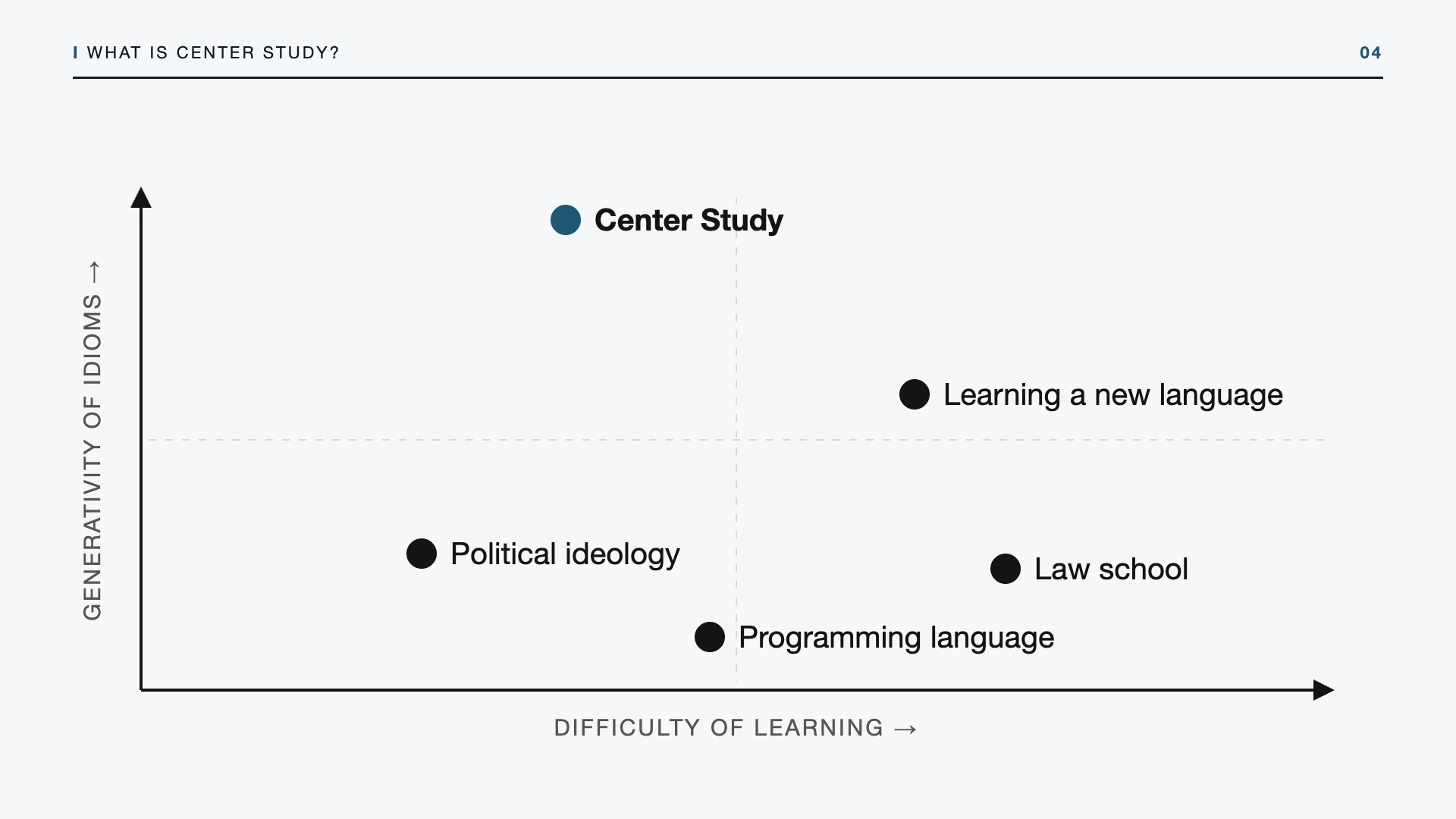
So this slide is a little bit tongue-in-cheek, but the idea here is to illustrate on the x-axis the difficulty of learning a new vocabulary or new idiom, and on the y-axis something I’m calling, provisionally, the generativity of idioms—i.e., how profoundly does the vocabulary you learn from the discipline shape your worldview and give you new insights and new ways of thinking about existing problems you’ve been wrestling with? So you can imagine learning a language like French, and different French idioms and vocabularies giving you new perches on the world—maybe French culture specifically, but also probably the English language, which will change for you once you’ve learned French. I want to say Center Study is much less difficult to learn than an entirely new language. However, it’s radically more generative once you’re able to start thinking in terms of the center. So it’s hard to take in—at least it resists a kind of “initiatory download,”↗ the way most “theory” lends itself to. But it’s precisely that difficulty that makes it such a generative way of thinking.
II. The Lineage
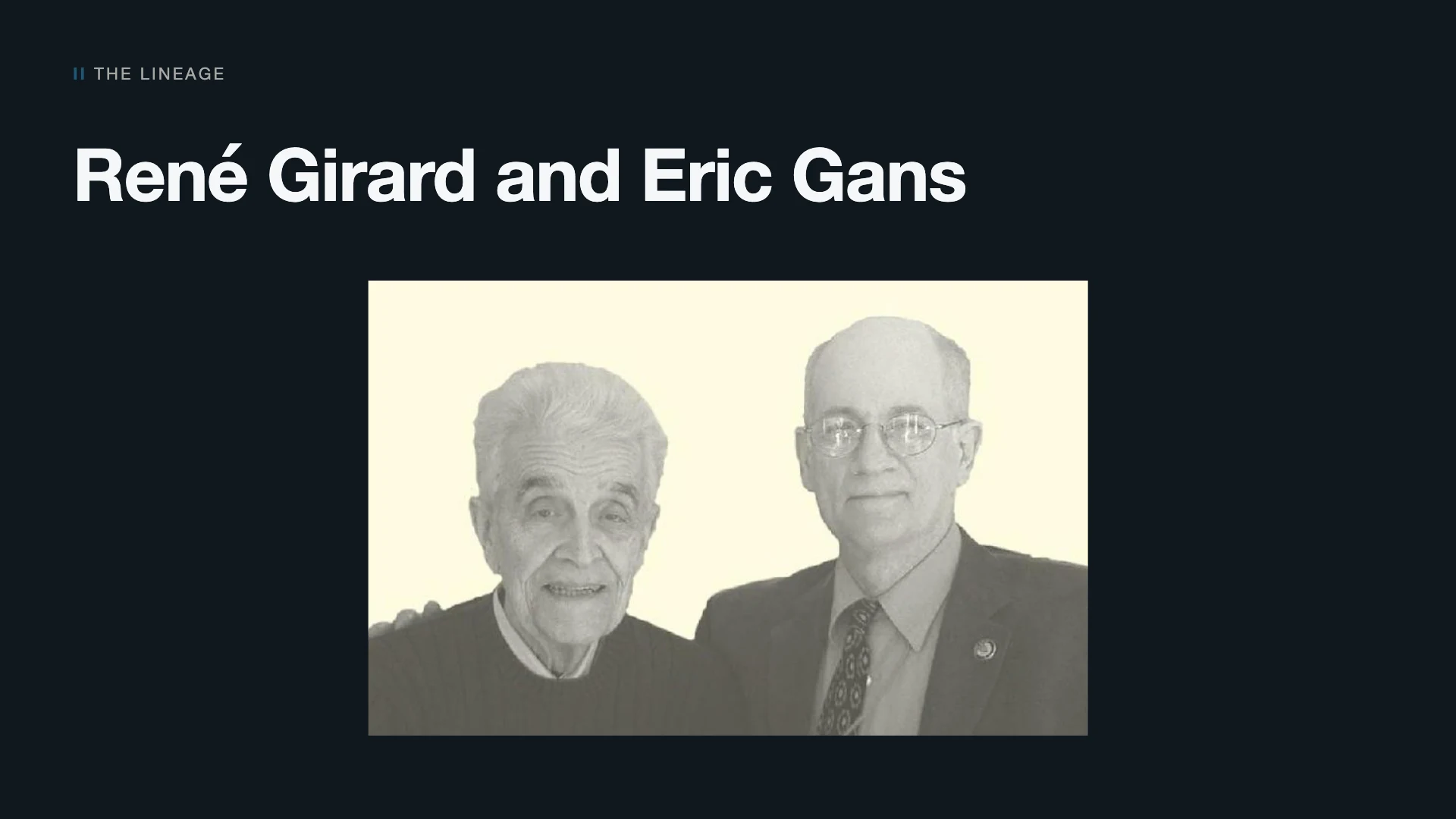
Center Study, like everything, comes from somewhere. And at least for this conversation, I want to try to situate its origin with René Girard. Who in this room has heard of René Girard? Okay, the whole room. So I won’t spend any time on Girard. This gentleman to his right is Eric Gans. Gans was among Girard’s first PhD students. Gans studied under Girard at Johns Hopkins—and realized that Girard had a kind of “plot hole” in his scapegoating mechanism.
In Girard’s model of the scapegoating event that founds the origin of the human, the proto-hominids—the not-yet-human creatures—gang up and lynch a selected individual. But the question for Gans was: why would this event be a meaningful one? In fact, animals kill individual animals in their groups all the time—and nothing “event-al” happens. The event isn’t meaningful. It’s not remembered. It’s not iterated. So Girard wants to say there’s something about this founding scapegoating event that radically transformed the community. But in order to do so, he must rely on some capacity for representation. The event must be represented to the community of now-human hominids as an event as such. Without this capacity for representation, the killing of the individual would be like it is in every other animal species: not meaningful, not iterated, not memorable, and certainly not sacred. For there to be some kind of origin where the sacred, representation, meaning, and language originate, one would have to explain how it is that the violent scapegoating generates this capacity for representation. If it didn’t already exist, the event wouldn’t be meaningful. And if it already existed, then you don’t need the event to explain it. It is that paradox that Gans resolves with his hypothesis about the origin of language.
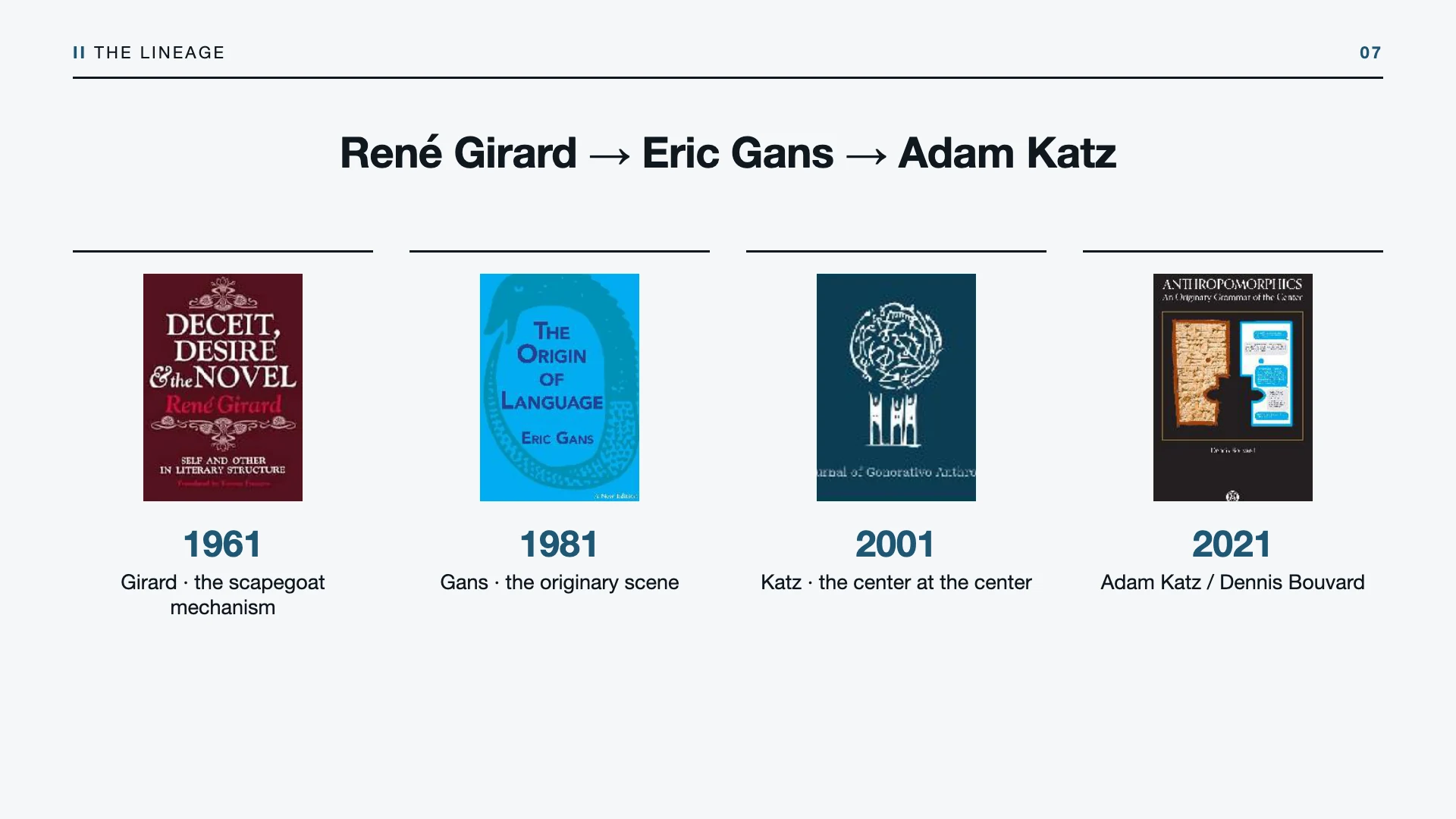
One way of thinking about the lineage is just isolating these different events, over twenty years, where the origins of each theory were first articulated. Girard releases Deceit, Desire, and the Novel in 1961. Gans publishes The Origin of Languagein 1981. Adam Katz—who writes under the pseudonym Dennis Bouvard—starts contributing to Anthropoetics, the journal of generative anthropology, in the early 2000s, and begins to take the absolutist turn, where he focuses on bringing the center back to the center. And this culminates in the forking of Center Study from generative anthropology in Adam’s book Anthropomorphics, released in 2020, and on his Substack, Center Study Center, which starts being published in 2021 and continues today.
That’s the lineage: mimetic theory, to generative anthropology, to Center Study.
III. The Paradox of the First Word
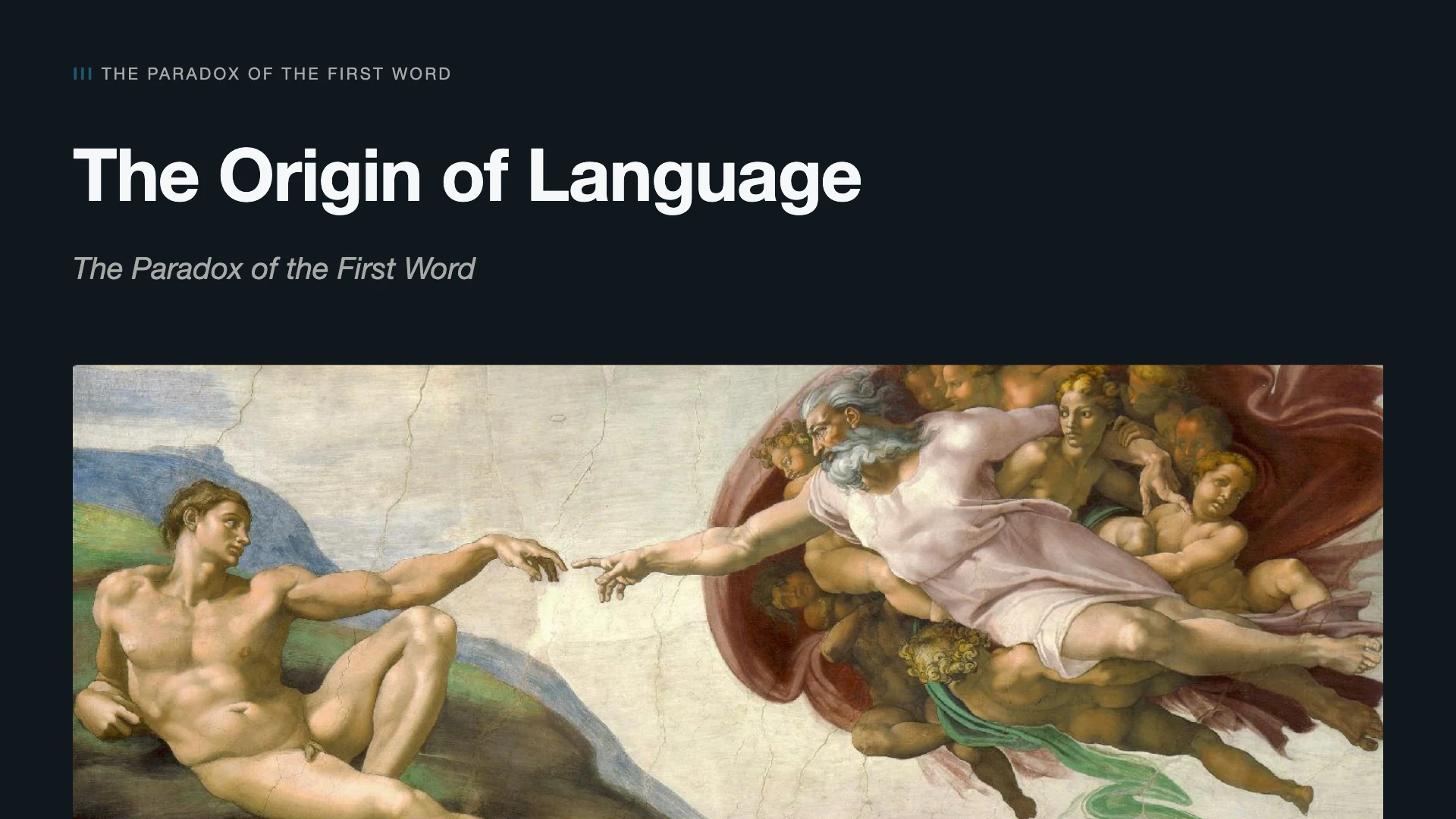
So what was this amendment? I want to begin with a paradox: the first word. Girard didn’t have a theory of the origin of language. It’s a hard problem to grasp, but once you see the problem, you’ll see how elegant the solution is. Where does language come from in the first instance?
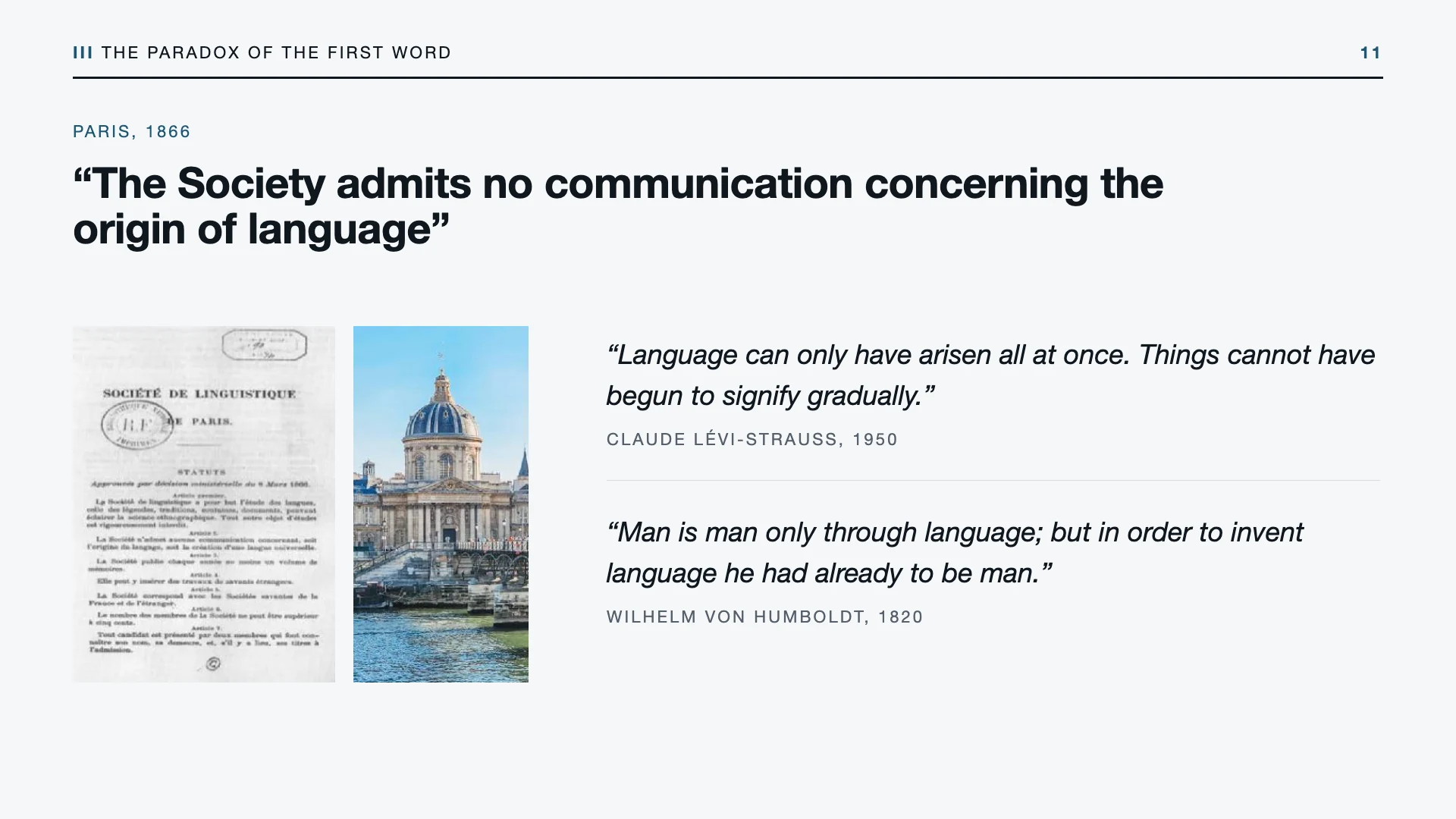
There’s a history here, with people like Claude Lévi-Strauss and Wilhelm von Humboldt. “Language can only have arisen all at once. Things cannot have begun to signify gradually.”↗ “Man is man only through speech; but in order to invent speech, he must already be man.” Rousseau has comments on this too. And I always point out that the Linguistic Society of Paris actually banned all discussion of the origin of language because no one could figure out the answer. We’re against the ban—which I think is probably still in force—so we’re going to break it and propose a hypothesis.
It’s very weird. Once you have some language, it’s clear you can get more; you agree on more words. But to go from zero to one, from no language to the first word, is a very strange problem.
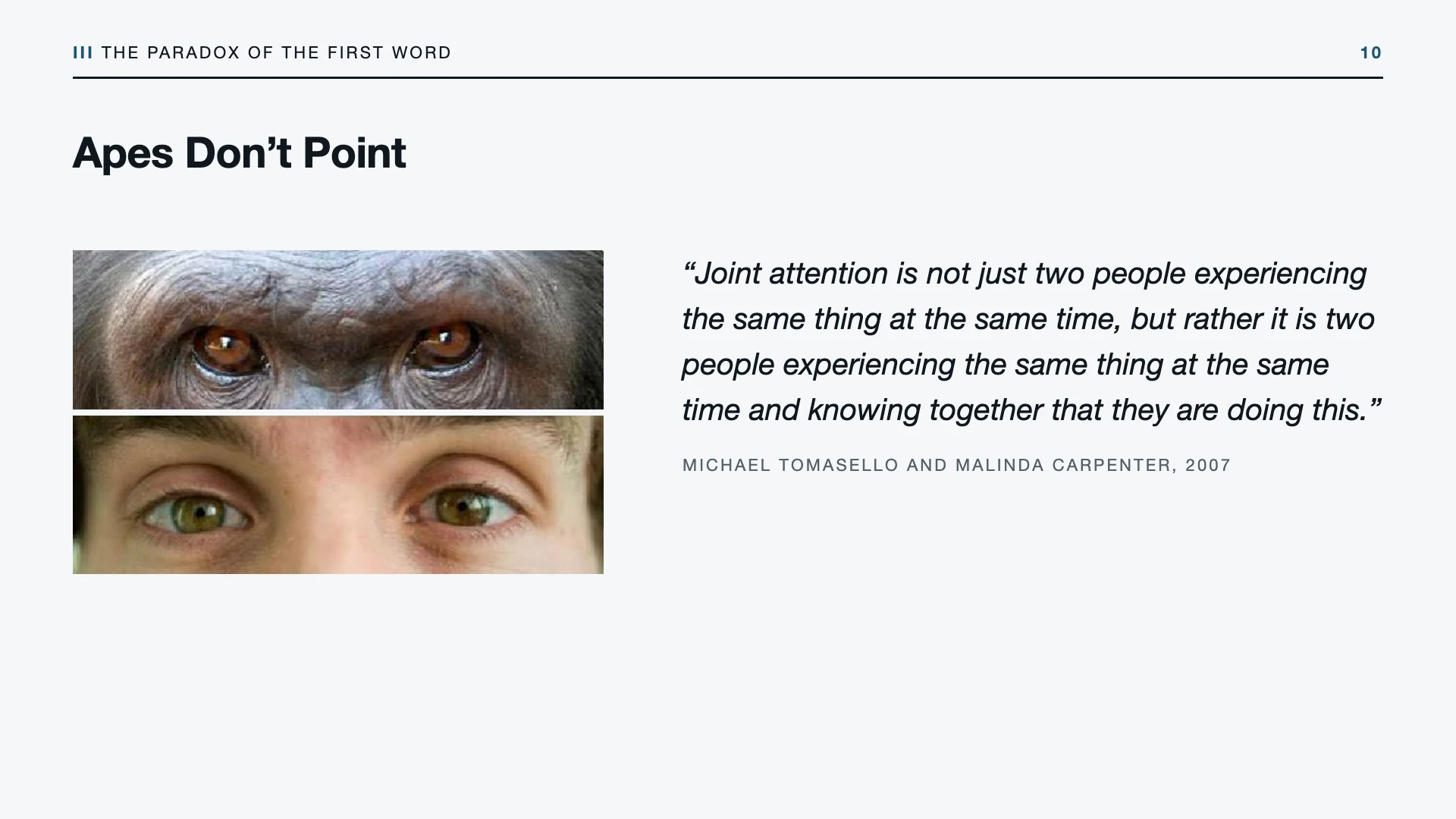
Briefly, it’s worth noting that apes don’t point. This is a simple point people often have trouble with, but there’s a lot of research on it—Michael Tomasello and many others. I know that you know that I know: third-order attention. I’m seeing you see me see something. No animal does this. I have five minutes of video, which I won’t play now, showing how apes and human babies differ in this way. Third-order attention—shared attention—is unique to the human species, and it’s part of how language emerges.
IV. The Originary Scene
It all comes together in what Gans called the originary scene, or the originary hypothesis. The punchline, if I can get you to remember one thing when you leave: the deferral of violence through representation.
Gans preserves from Girard the violent origin, but unlike Girard, it’s not violence that forges the human—it’s non-violence. It’s our ability to withhold. Not so much free will as free won’t. Humans are non-instinctual creatures. We don’t just act on our animal appetites; we’re also able to withhold them.
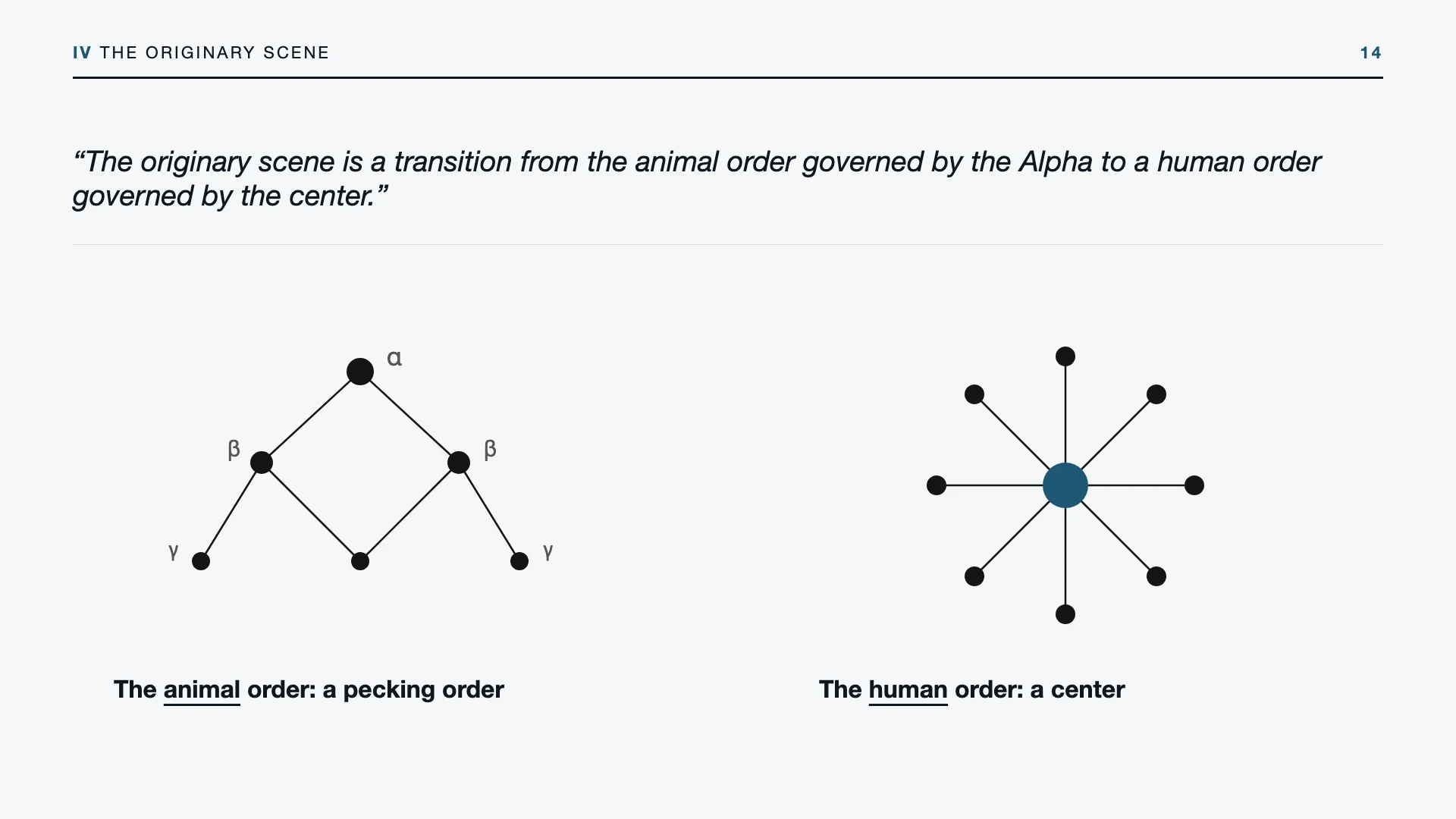
Think about an animal pecking order: alpha, beta, gamma, sigmas somewhere down there—I see some in the crowd. It’s normally one against all. It’s the alpha beating the beta for the meat. That’s how wolf packs and ape hierarchies work. The human has a very different structure: centripetal, organized around a center. The originary hypothesis explains how you go from the animal pecking order to this human order—which, by the way, is hierarchical, not egalitarian.
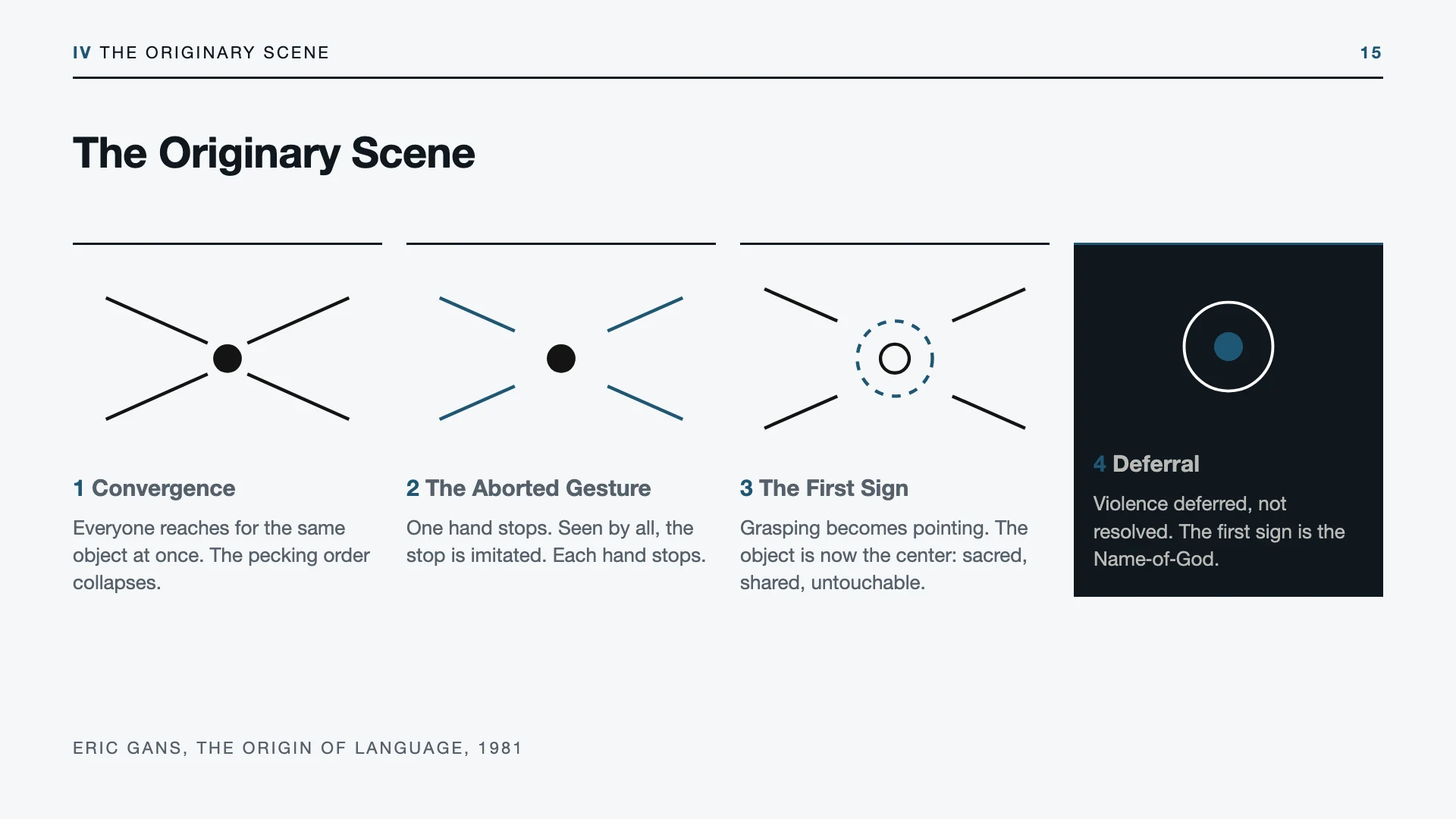
Here is the scene. In the beginning you have a highly mimetic proto-hominid species that comes across an appetitive object they all desire—some kind of food. They all reach for it at the same time. As they reach, there’s something not quite a realization but a fear that if everyone goes for it at once, violence will ensue. At least one of the animals—likely a sigma, someone not quite the alpha, someone in the middle—holds back and turns a gesture of appropriation, of grabbing, into something like a point. That gesture is recognized by others and imitated, and they all point at the object.
That scene, or something like it, was the first sign and the first word, and it meant something like stop, or hold back. They did something no animal has ever done: shared attention on a central object. That is deferral. They deferred the violence. The sign meant “we’re going to hold back,” and then they would have gone forward and eaten the object. Maybe tensions rose again as they tore into the shared carcass, and maybe they issued the sign again.
This very simple gesture—which you might notice is very similar to the pointing gesture at the origin—becomes a sign that means not quite love, though I want to say something like love. It’s the ability to restrain yourself and let things be, and in that being, anything is possible. That’s what deferral is, and that’s what generativity is.
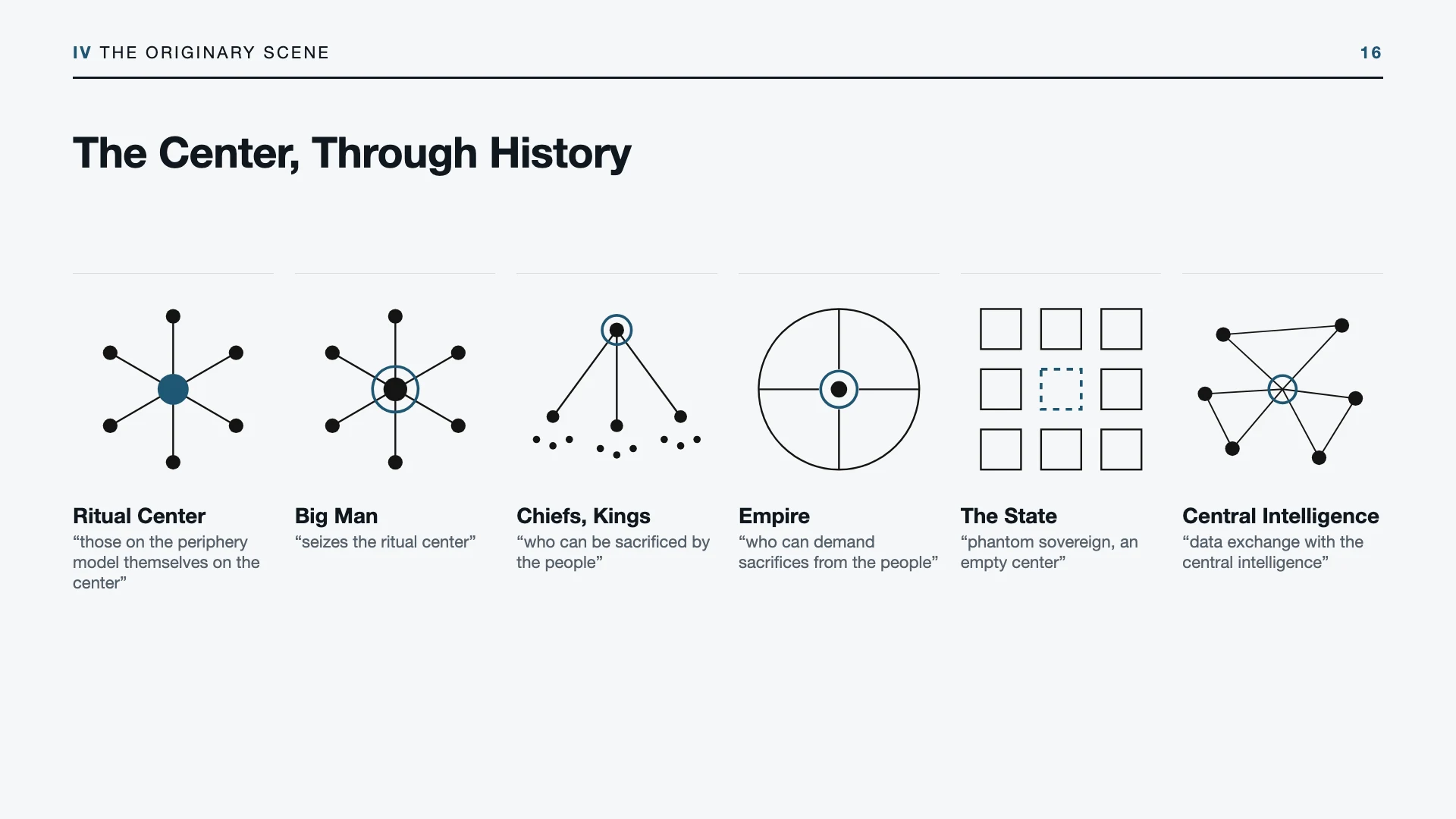
You have this originary scene far back in our prehistory, and then you have the center throughout history. The point of Center Study is to start with that originary point and trace it through history like a thread: the first chiefs, the early kings, the empires, the twentieth-century states, and ultimately the central intelligence and the new kind of center we’re opening into today. The center extends, and we can use the vocabulary of the center to talk about each of these and make them compatible with one another. It’s a very minimal vocabulary that can explain the anthropology and the political theory of our social orders.
V. Center Study as Idiom Laboratory
So what is the discipline? It’s an idiom laboratory. That sounds like a crazy claim, but two sentences get at it.
First: if you want to infiltrate and reshape a scene, you need to be primarily concerned with formulating idioms that will stick, proliferate, and turn into networks.↗ I think this is even more true in the age of artificial intelligence and large language models. What matters is that the idioms you create—the new language, the neologisms, the terms you coin—go places. They succeed. They fly through the networks, come back to you, and work as new modes of thinking.
Second: style is technology. If you imitate and translate another’s style, you’ll be saying things you wouldn’t have thought of otherwise. Idioms are shared styles, and creating styles of learning idioms is a way of proposing new idioms.↗
The goal is new idioms, new maxims, new durable phrases that let other people think in new ways. This goes back to the beginning: other disciplines are shutting down thinking, and the goal of Center Study is to radically open it up—radical in the sense of the root, the origin point. We always want to go back and see what more we can say.
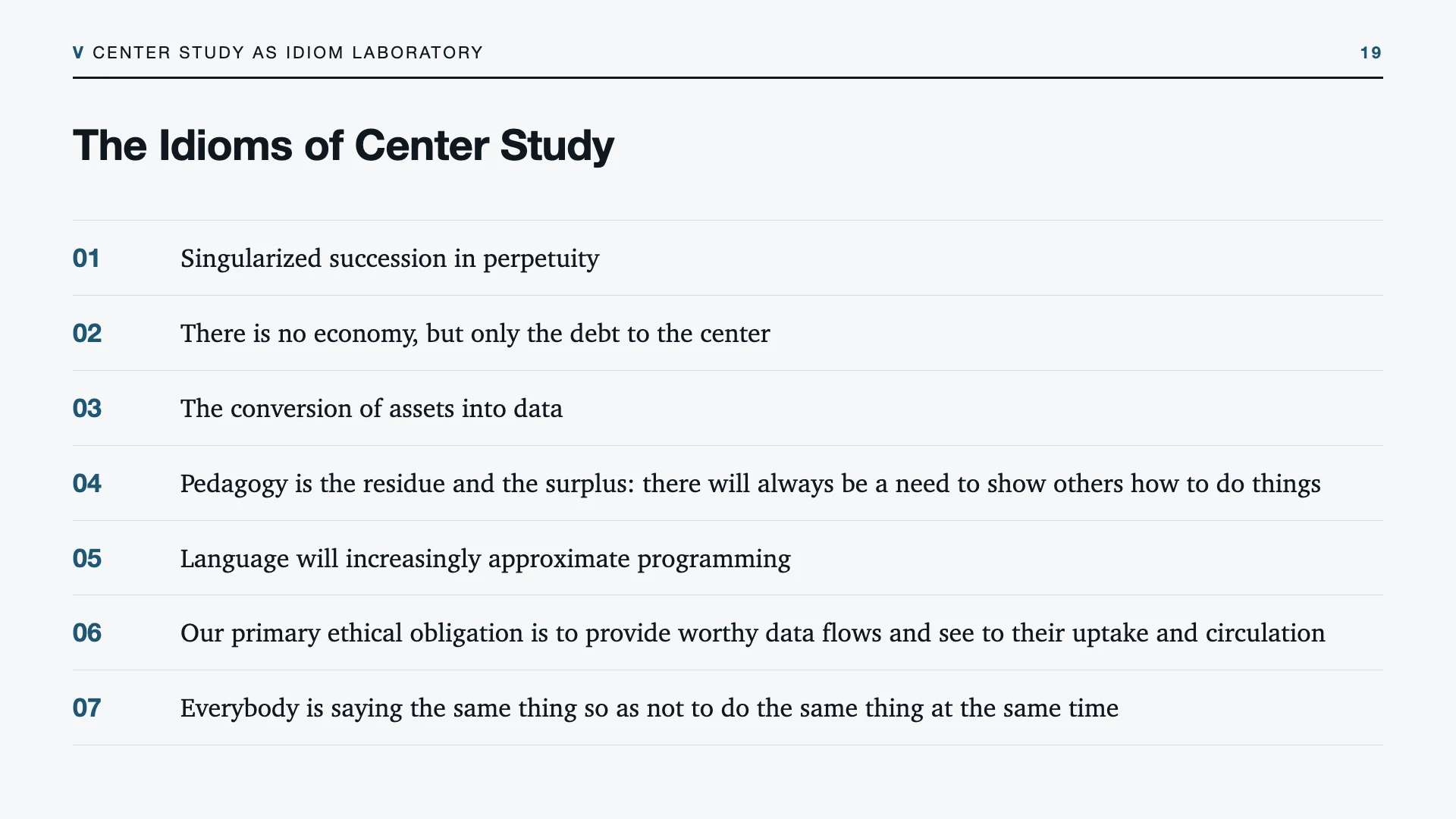
Here are seven idioms I selected; I’ll talk through a few.
Singularized succession in perpetuity. All political problems are succession problems. Who is going to lead in the future? How do you make that continuity a priority throughout the social order?
There is no economy, only the debt to the center. This is the title of an article I co-authored with Adam↗, but the phrase is more than that. From the first animal sacrifice to the Fed’s quantitative easing yesterday, we can think about the economy as a debt and credit relationship with the center itself.
The conversion of assets into data. There’s a lot to say here, but let’s say money itself is just data, and will become more so.
The infinite exhaustibility of pedagogy. There will always be a need to show others how to do things. When we think about what large language models are doing to work and the social order, one thing we’ll never run out of is ways of teaching and learning from each other. Something like continual learning is what the economy turns into.
Language will increasingly approximate programming. Our programming will increasingly be done in language, and language becomes a kind of programming we’re always doing. One way to describe Center Study is as a language programming language—a way of getting at language itself, from the origin, in order to work on language. A lot of what we’ll be doing is working on language in meta-linguistic ways.
VI. What Is to Be Done?
If you take Center Study and the originary scene seriously, what can you do? One idiom I haven’t said yet: No theories but in companies; no companies but through sovereignty. All of the idioms need to turn into companies.
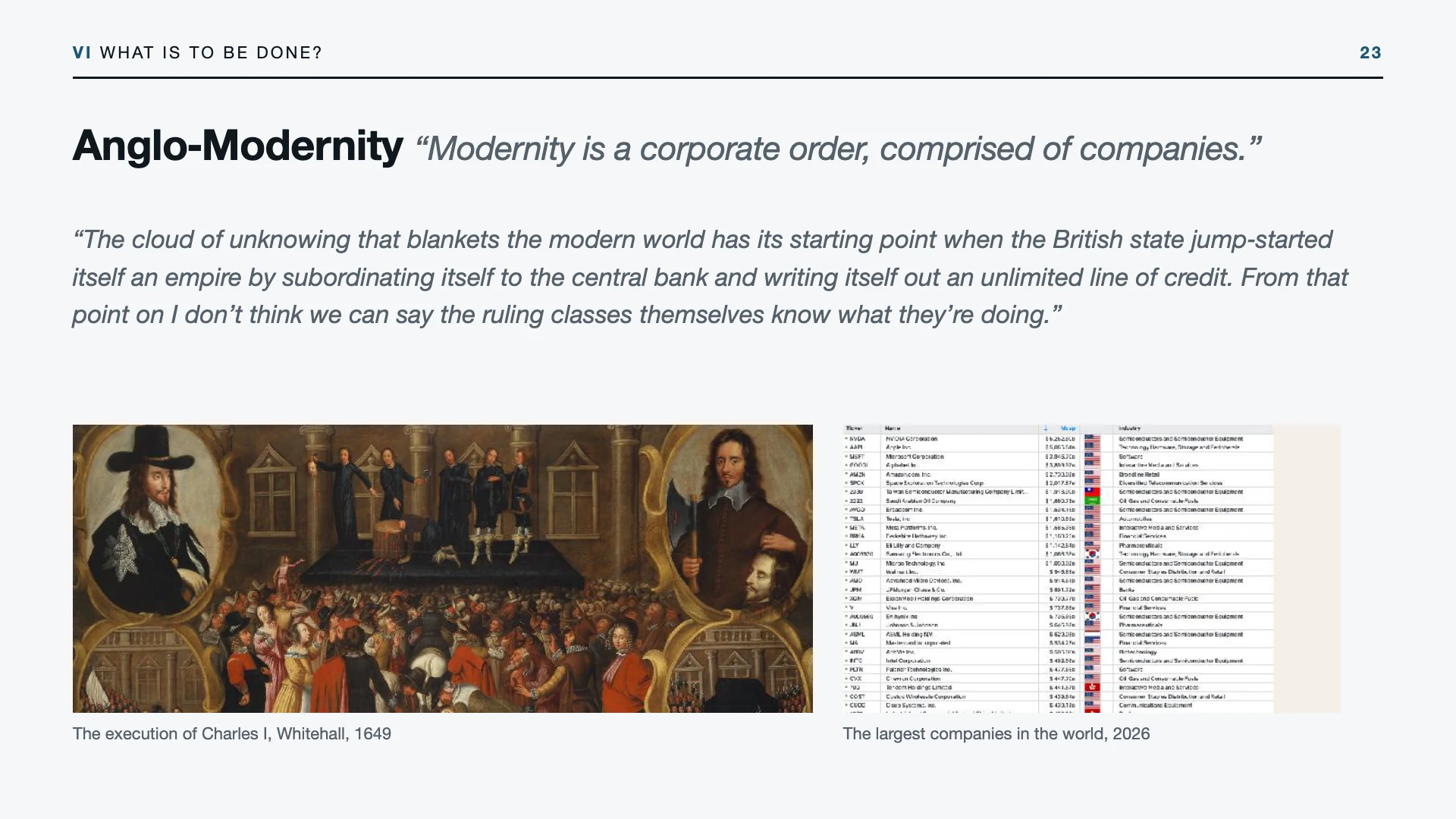
Why? We’re in something I call Anglo-modernity. Modernity is a corporate order comprised of companies. In the premodern world you had tribes, familial relationships, kinship networks. In modernity you have a legal order. This begins, I want to say, with the execution of Charles I—the first time in human history a monarch is executed not by a rival faction but after being put on trial. For the first time the people assert sovereignty over the center. The center is punctured, and we’ve been dealing with the wound ever since.
Look at the largest companies in the world: they are all American companies. The modern world is in some sense the Anglo-American empire. It’s the US dollar order. It’s an order comprised of companies. And if you’re serious about your ideas, you need to turn them into companies.
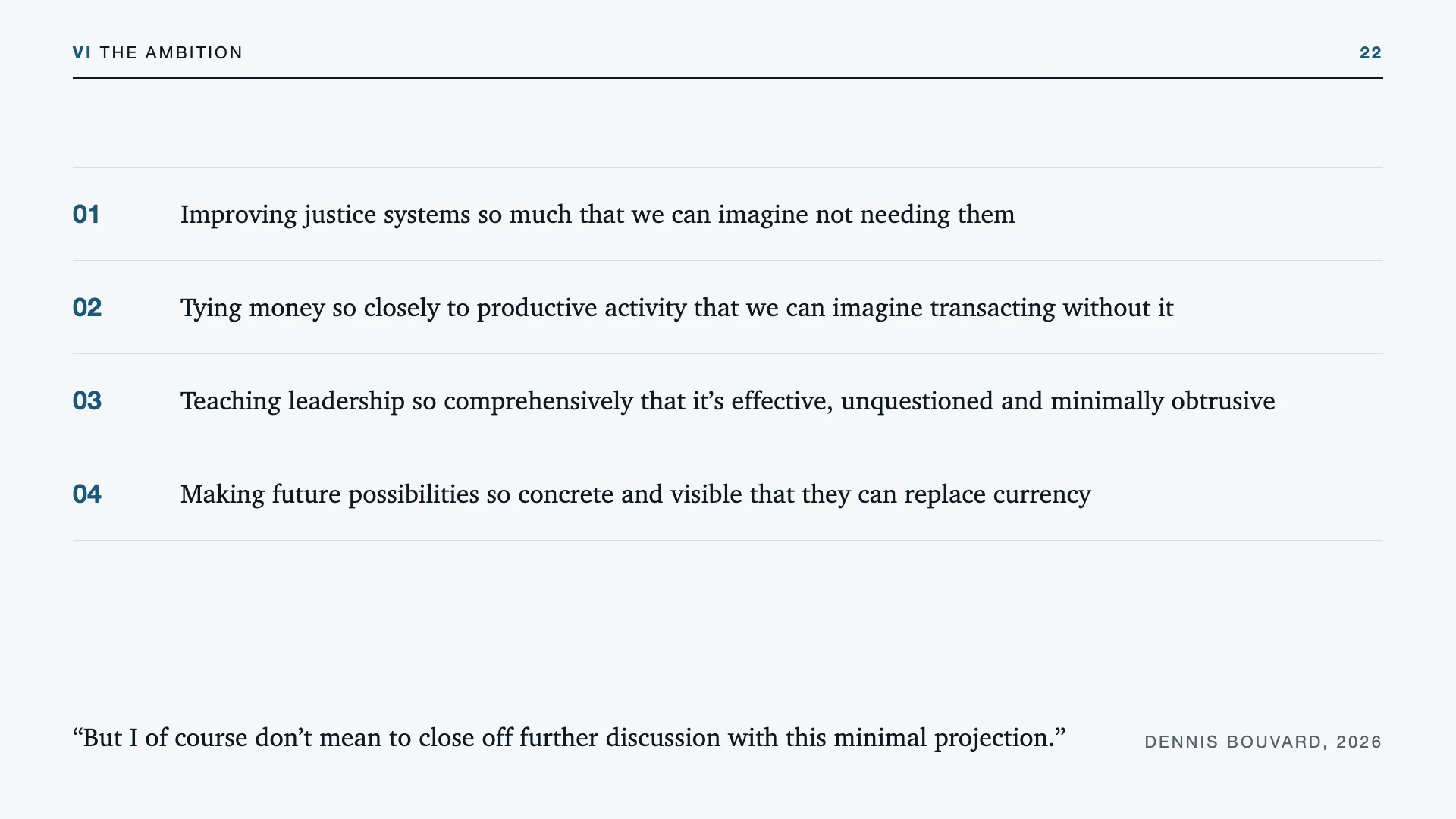
Here are a few company ideas from Adam:
- Improving the justice system so much we can imagine not needing it.
- Tying money so closely to productive activity we can transact without it.
- Teaching leadership so comprehensively that it’s effective, unquestioned, and minimally obtrusive.
- Making future possibilities so concrete and visible that they can replace currency.
And then he closes the list: “But I of course don’t mean to close off further discussion with this minimal projection.” These are very minimal. Where we’re going is far more radical than any of this. But take the justice one: justice so deeply inscribed into the social order that people don’t commit crimes because they know they’d be prosecuted. You don’t even need a justice order because it works so well.
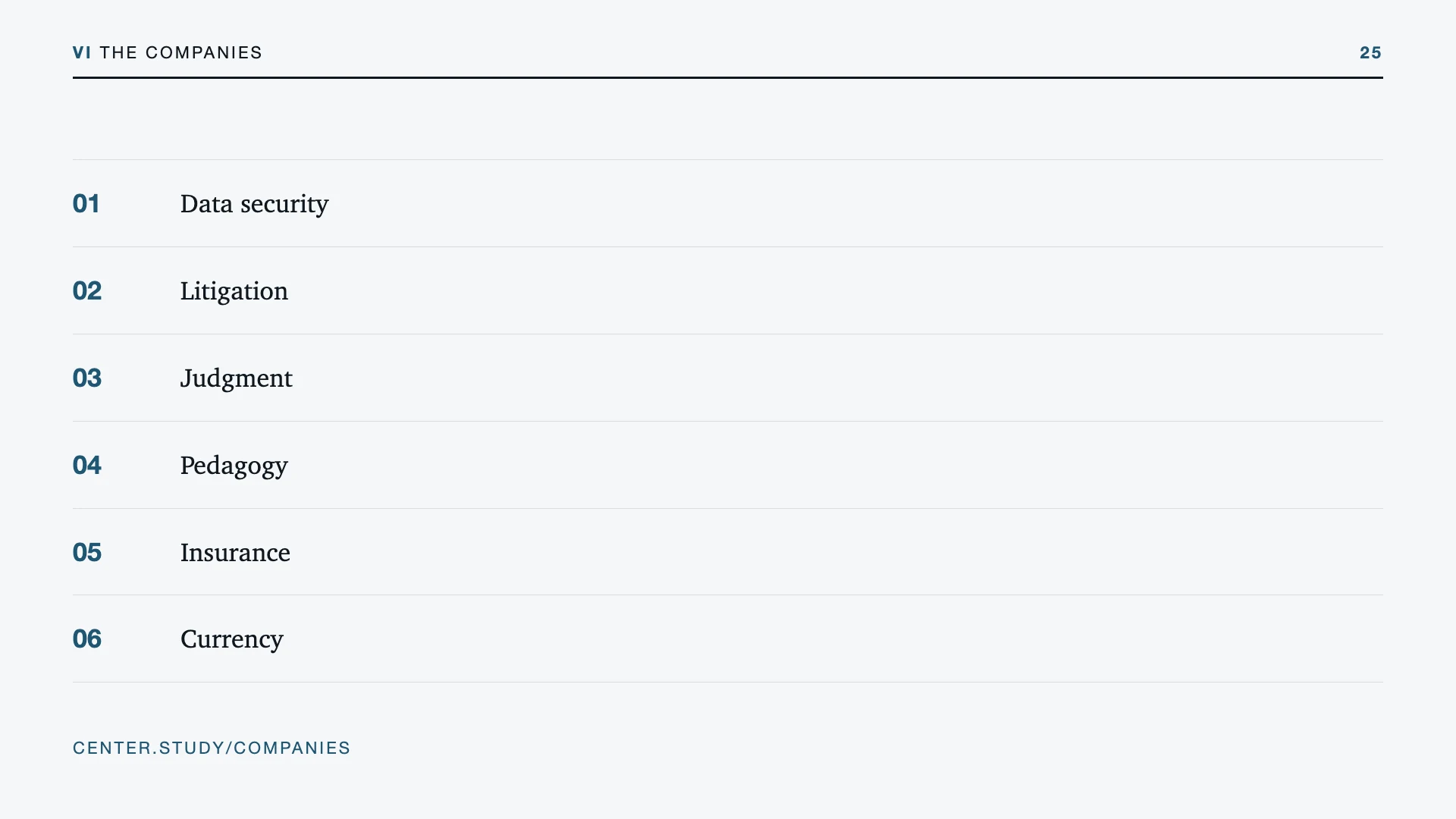
Some categories of companies: data security, litigation, judgment, pedagogy, insurance, currency.
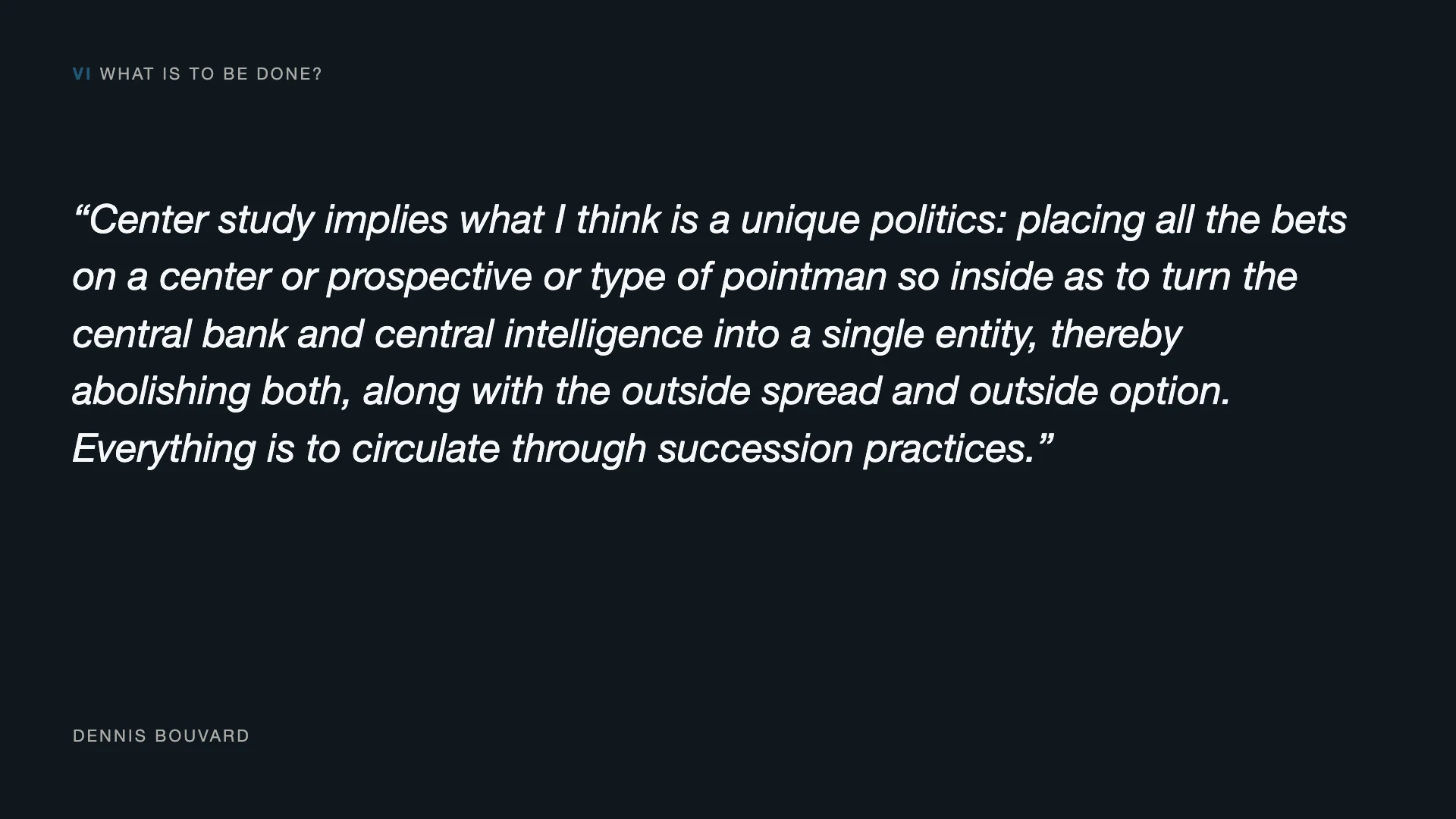
Center Study implies what I think is a unique politics: placing all the bets on a center or prospective or type of pointman so inside as to turn the central bank and central intelligence into a single entity, thereby abolishing both, along with the outside spread and outside option. Everything is to circulate through succession practices.↗ That’s a lot, and I could go through those terms, but the idea is this: at the beginning of Anglo-modernity you get the first central bank, the first central intelligence, parliamentary governance—the modern world. Part of what Center Study will do is bring all those dislocated, factional, infighting elements of sovereignty and governance into a single entity.
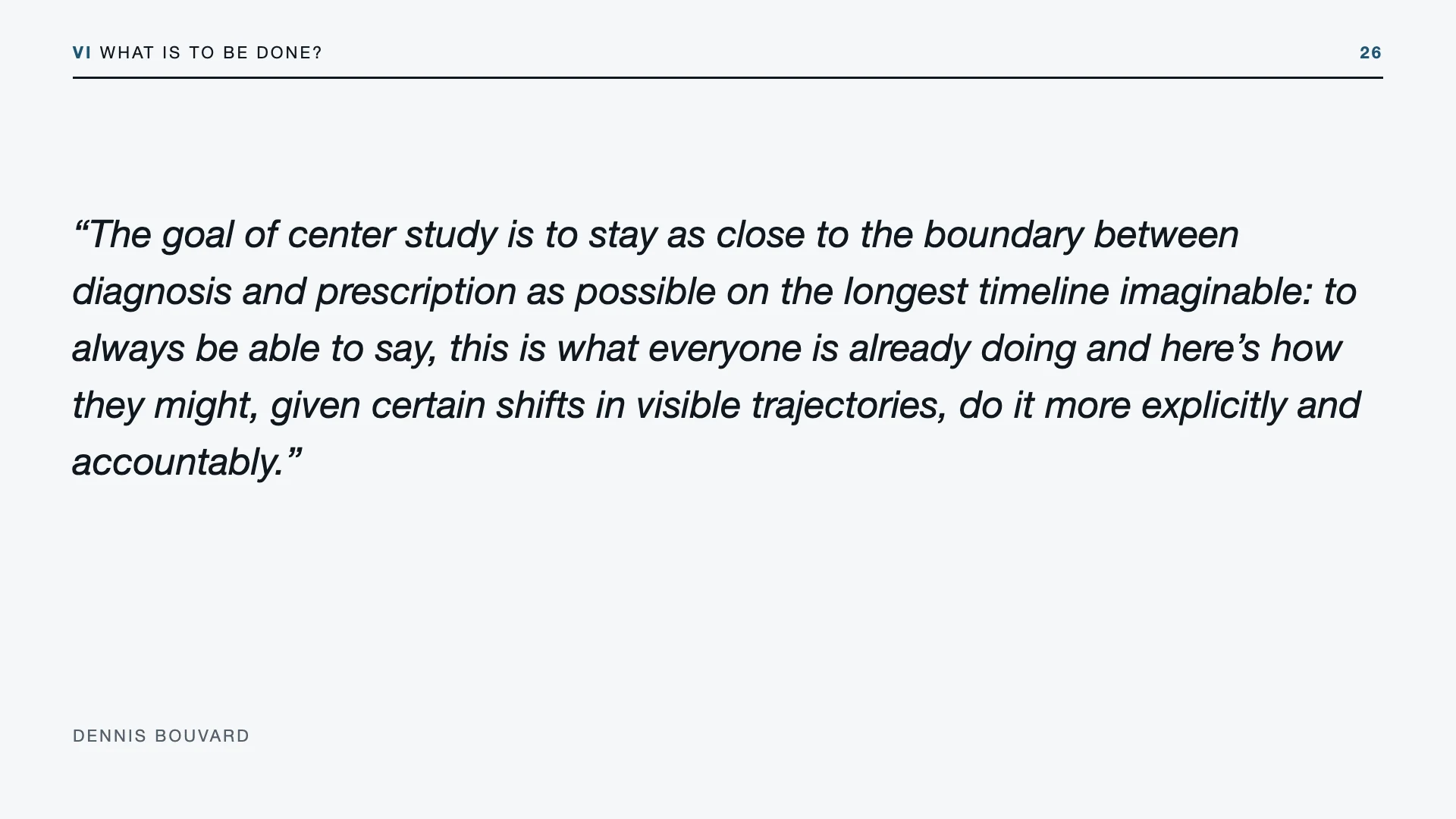
There’s an oscillation with many of these idioms, where at one level they seem very profound and at another very trivial. That’s because what we’re trying to do is describe, first, what we’re already doing, and second, how we might do it even more explicitly.
So that’s Center Study. There’s a Center Study Twitter account if you want to follow along. Thank you everyone, and now we’ll go into Q&A.